
Strike Tiger
There are 108 moves in the Tai Chi set we practice in Ash Vale. Whilst this seems like a lot there is a lot of repetition meaning you only really 40ish moves to learn. Getting them in the right order however is a whole different ball game!
Anyway, we have reached move 42: Strike Tiger with Fist.
It begins as many moves do with a kick. We then drop down to face the corner then rise up pushing our hands high in front. The left hand falls and hips turn to strike tiger left. We then turn 180 degrees and drop the right hand to strikes tiger right:
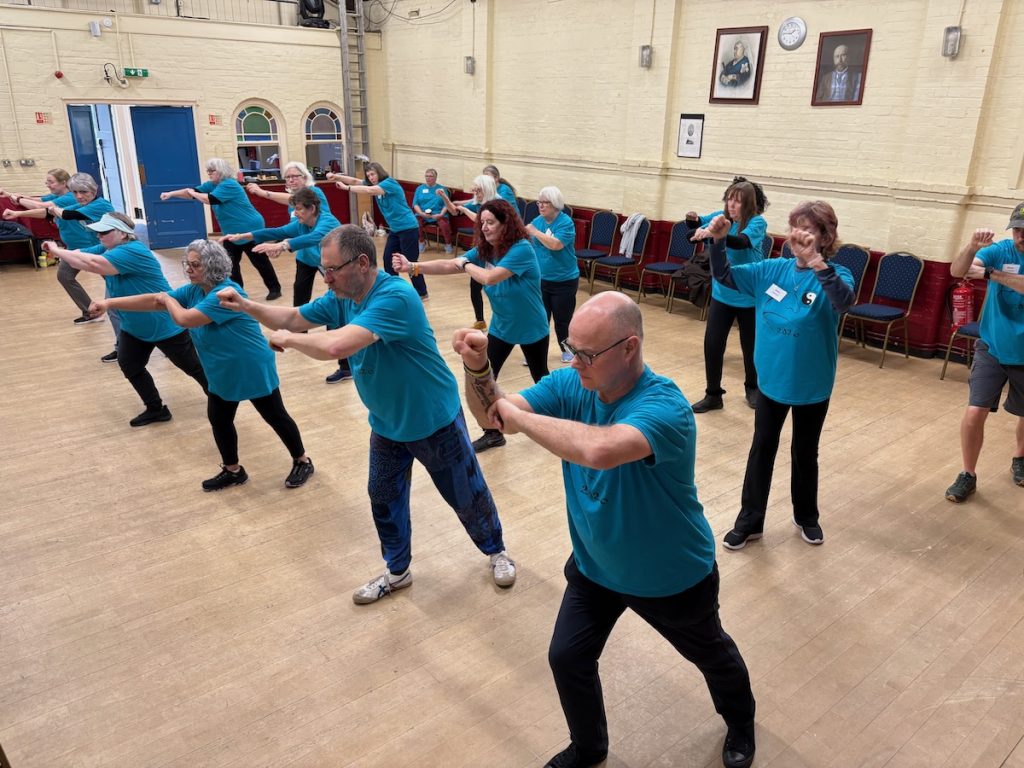
All good so far.
One of the key benefits of Tai Chi is improved balance. We practice this now with the last of the tiger strikes.
Settling the weight back on the left foot the hands sweep round and then open at the same time as we raise the right foot and kick. Still balanced on one leg we drop down and place the right foot on the floor keeping the weight on the left leg. Often a bit wobbly but when you get it right it feels good. Last part of the move is to shift the weight to the right leg and bring both hands round to strike both of the poor tigers ears.
Everyone who newly attends the class reckons they can’t balance. But they always surprise themselves and end up standing with one foot in the air.
Why Strike Tiger?
Postures like this appear in a number of Tai Chi forms. Their names often refer to tigers, yet there is nothing in the physical shape of the posture itself that necessarily suggests a connection to the animal. To understand the reference, we need to look beyond the movements and into Chinese folklore, where the imagery and symbolism behind many traditional names can be found.
One of the most famous works of Chinese literature is Heroes of the Water Margin, also known as Water Margin or Outlaws of the Marsh. This collection of loosely connected adventure tales occupies a place in Chinese cultural history comparable to that of The Iliad and The Odyssey in the West. Its characters and stories have become so deeply embedded in Chinese culture that people may refer to them without even being aware of the original source. One such character is the legendary Wu Song.
In one of the best-known episodes, Wu Song stops at an inn and drinks heavily. Despite warnings that a man-eating tiger inhabits the nearby forest, he sets off rather than staying overnight. He eventually encounters the tiger, which attacks him, and a desperate struggle follows. Wu Song manages to overcome the animal, killing it with his bare hands. His extraordinary feat earns him fame and leads to his appointment as a local official.
In traditional depictions, Wu Song is often shown astride the tiger, striking it with his fists. This distinctive image provides the cultural reference for postures found in Chinese martial arts, including Tai Chi, that are known as “Strike Tiger Left” and “Strike Tiger Right.” The names make more sense when we recognise the familiar image they evoke, even if the postures themselves do not look particularly tiger-like.
This is an important reminder that Tai Chi is more than a sequence of physical movements. Its traditional names reflect a rich cultural heritage, drawing on folklore, literature, symbolism, and the martial traditions from which the art developed. Sometimes a name offers a clue to the movement’s martial application; sometimes it evokes an image, an idea, or a story familiar to earlier generations of practitioners. The connection may be practical, symbolic, or simply cultural.
In the case of “Strike Tiger,” the reference is primarily to a well-known figure from Chinese folklore rather than to a literal technique for fighting a tiger. Understanding the historical and cultural background of a posture adds another dimension to practice. It helps us appreciate not only how we move, but also the stories and traditions that have helped shape the art we practise today.